Smart Plant Pot
Eco-Friendly Monitoring System
An intelligent system designed to monitor soil humidity and alert users, ensuring optimal health for your plants through smart sensing.
Smart Monitoring
Real-time soil moisture tracking.
Interactive Alerts
LED and Buzzer notifications for watering.
Custom Design
Fully integrated electronics and 3D printed structure.
Technical Documentation
FINAL PROJECT
Smart Plant Pot – Maceta Inteligente Eco
Student: Cindy Marilyn Crispín Fab Lab: Fab Lab Huando Year: 2026
Project Summary
The Eco Smart Planter is an interactive system designed to monitor soil moisture and alert the user when a plant needs to be watered.
The project integrates sensors, embedded electronics, programming, 3D design and digital manufacturing to create an educational device that promotes responsible plant care.
The system uses an HL-69 Soil Moisture Sensor to measure soil moisture. The information is processed by an ATtiny Microcontroller designed on a custom PCB.
When the humidity level is low:
• an RGB LED changes to red • a piezoelectric buzzer emits an audible alert
When the soil has sufficient moisture:
• the LED changes to green • the system indicates that the plant is in adequate condition
This project demonstrates the integration of multiple digital and electronic manufacturing processes to build a functional product.
Main Image
Debe mostrar claramente:
• la maceta ensamblada • la planta colocada • el sensor en la tierra • el LED funcionando • sin cables visibles
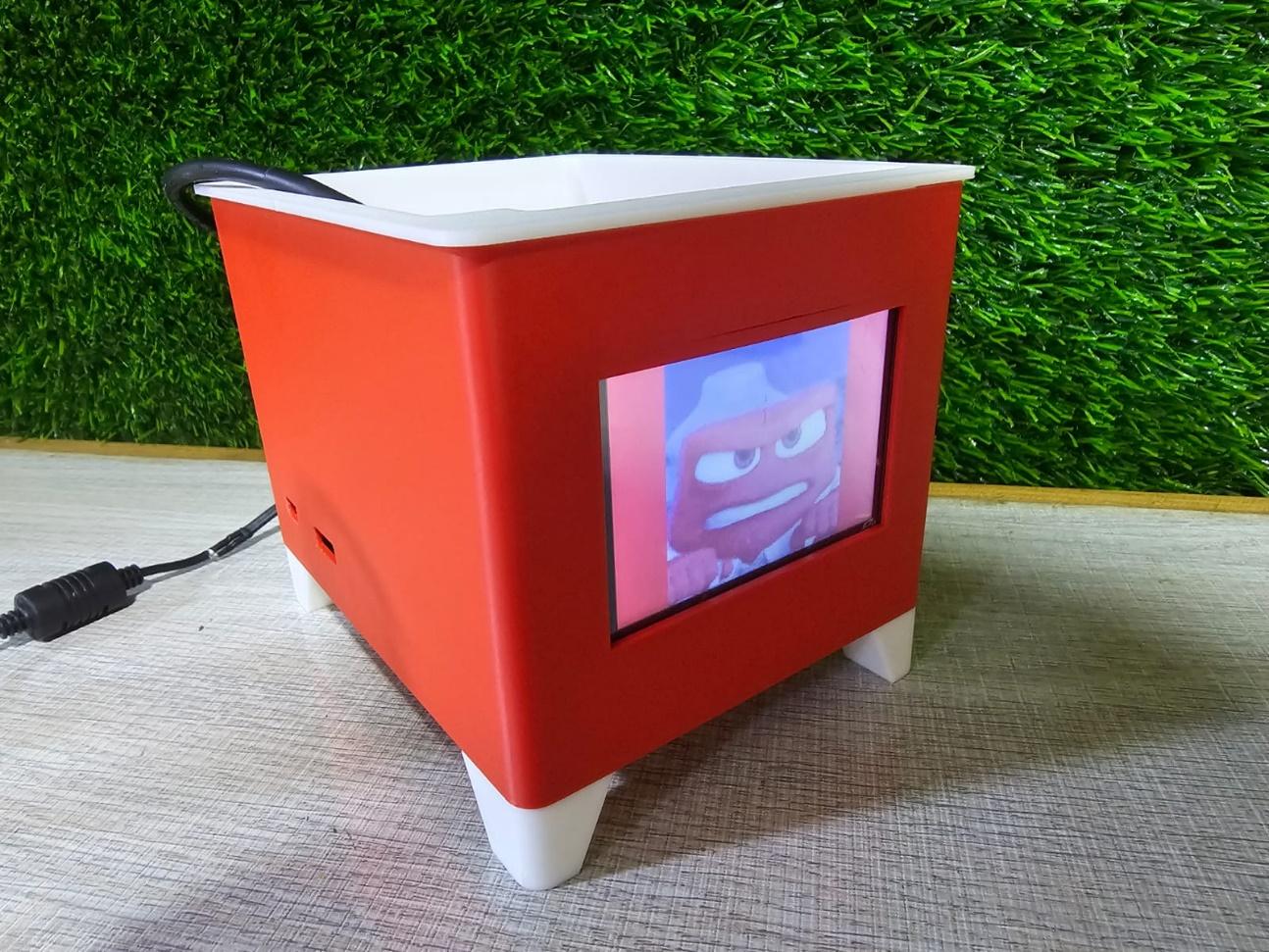
Figure 1. Final prototype of the Smart Plant Pot integrating electronics, sensors and embedded programming.
File in the root of the site:
What does it do?
The Eco Smart Pot monitors the state of the soil in real time and tells the user when it is necessary to water the plant.
The system detects soil moisture through the sensor and uses a microcontroller to process the data and activate visual and audible alerts.
This allows anyone to care for plants more efficiently, avoiding both overwatering and underwatering.
Project Motivation
Many people have plants at home or at their workplace, but they don't always know when is the right time to water them.
The lack of information about the state of the soil can cause:
• dehydrated plants • excess water • deterioration of plant health
The Eco Smart Planter seeks to solve this problem by providing a simple system that monitors soil moisture and alerts the user when watering is necessary.
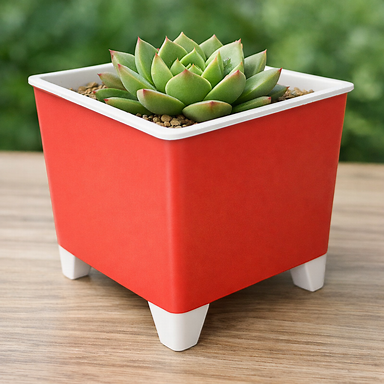
Figure 2. Example of plant care where monitoring soil humidity is important.
System Architecture
The system is made up of several electronic modules that work together to monitor and communicate the status of the plant.
Componentes principales:
• soil moisture sensor • ATtiny microcontroller • RGB LEDs • piezoelectric buzzer • Custom PCB
System operation:
The sensor measures soil moisture
The microcontroller processes the information
If the soil is dry: • LED changes to red • buzzer emits alert
If the soil is wet: • LED turns green
System diagram.
Debe verse:
Sensor → Microcontrolador → LED / Buzzer
Figure 3. System architecture of the smart plant pot.
What did I design?
During the development of the project I designed multiple components, both mechanical and electronic.
Diseñé:
• parametric 3D model of the flowerpot • internal support for the PCB • electronic schematic • PCB board layout • microcontroller firmware • product integration system
All files were created or significantly modified by me during the development process.
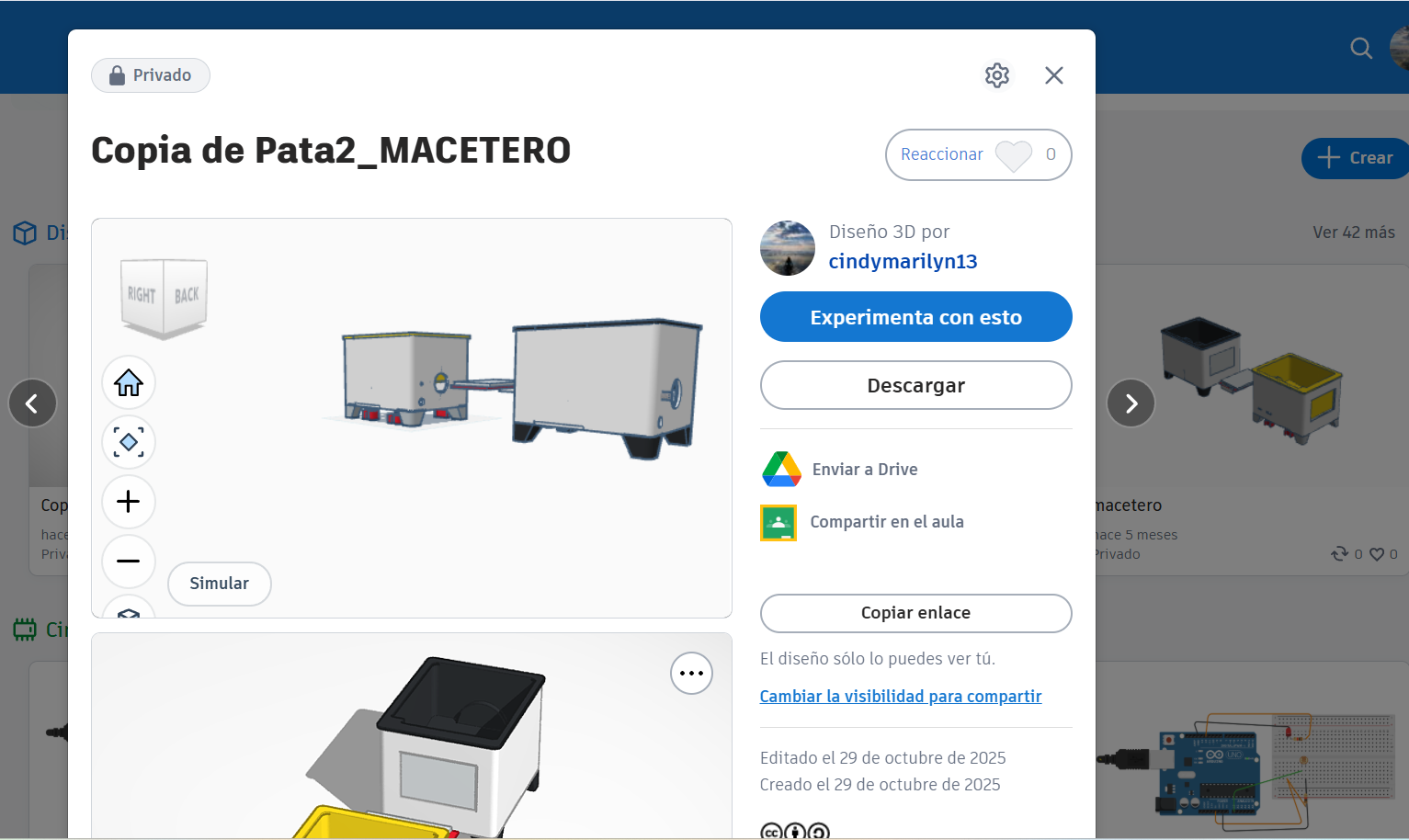
Capture of the 3D model of the flower pot.
Figure 4. CAD model of the smart plant pot designed for the project.
Electronic Design
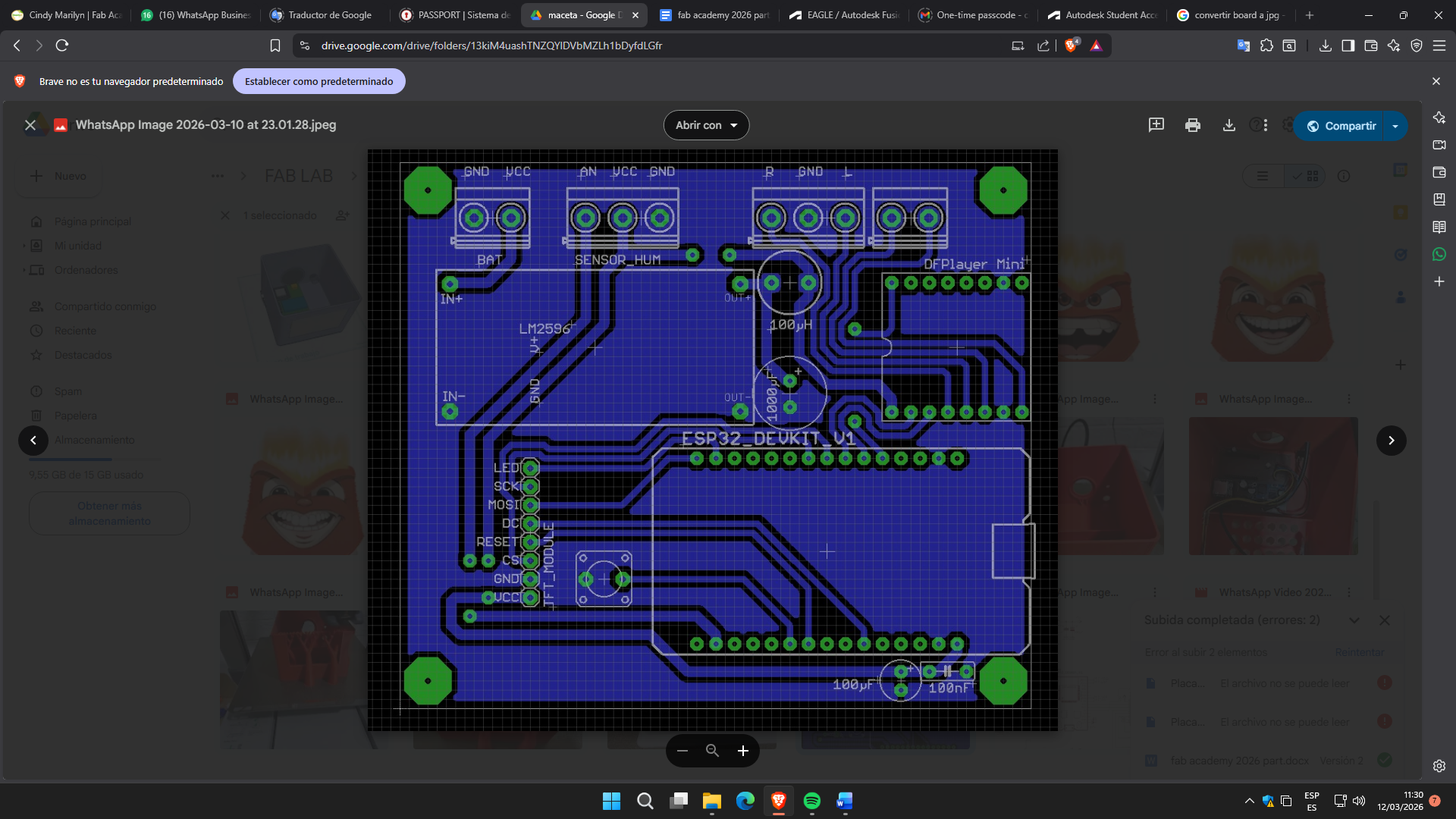
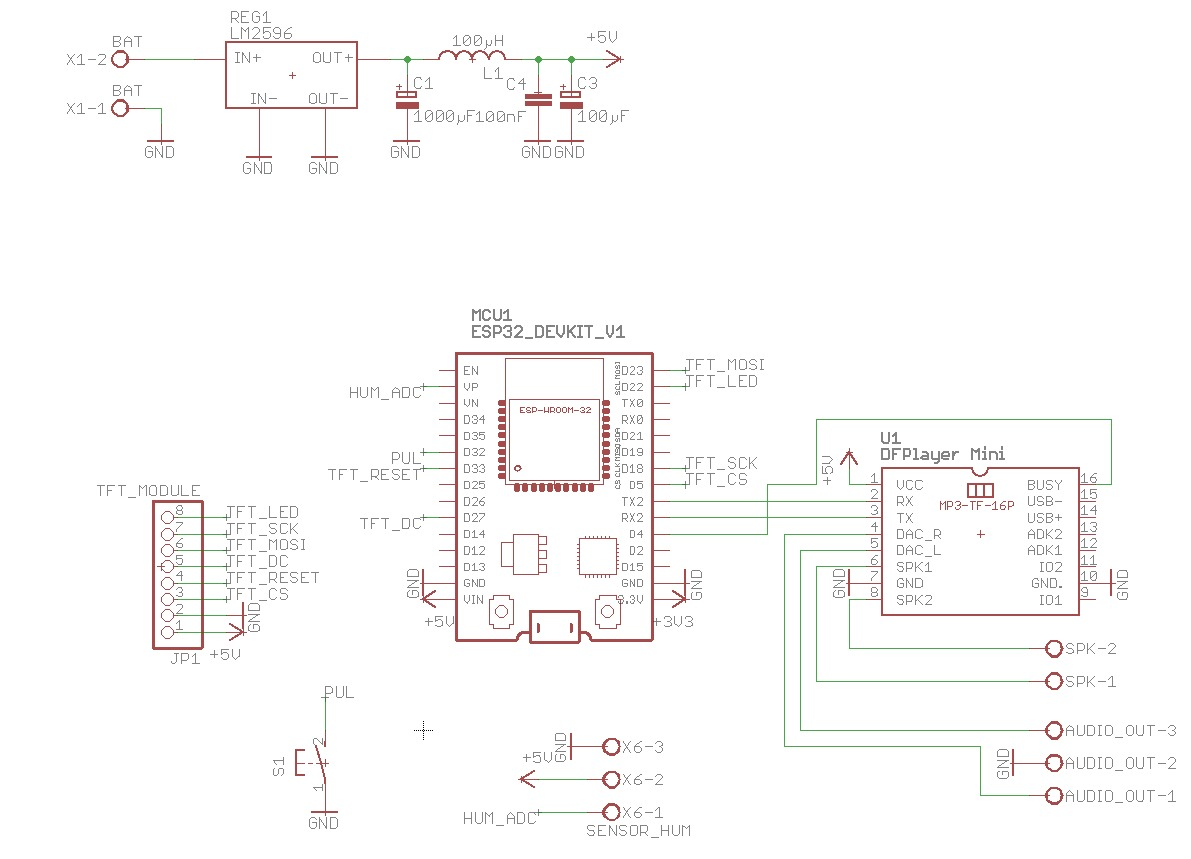
The electronic system was developed by designing a custom PCB based on an ATtiny microcontroller.
La placa incluye:
• microcontroller • resistors • sensor connections • output for LED • buzzer output
Esquemático electrónico.
Figure 5. Electronic schematic of the smart plant pot PCB.
Board design.
Figure 6. PCB layout designed for the project.
Fabrication Process
The project integrates different digital manufacturing processes.
Procesos utilizados:
• 2D PCB design • parametric 3D design • 3D printing of the flower pot • PCB milling • electronic welding • embedded programming • systems integration
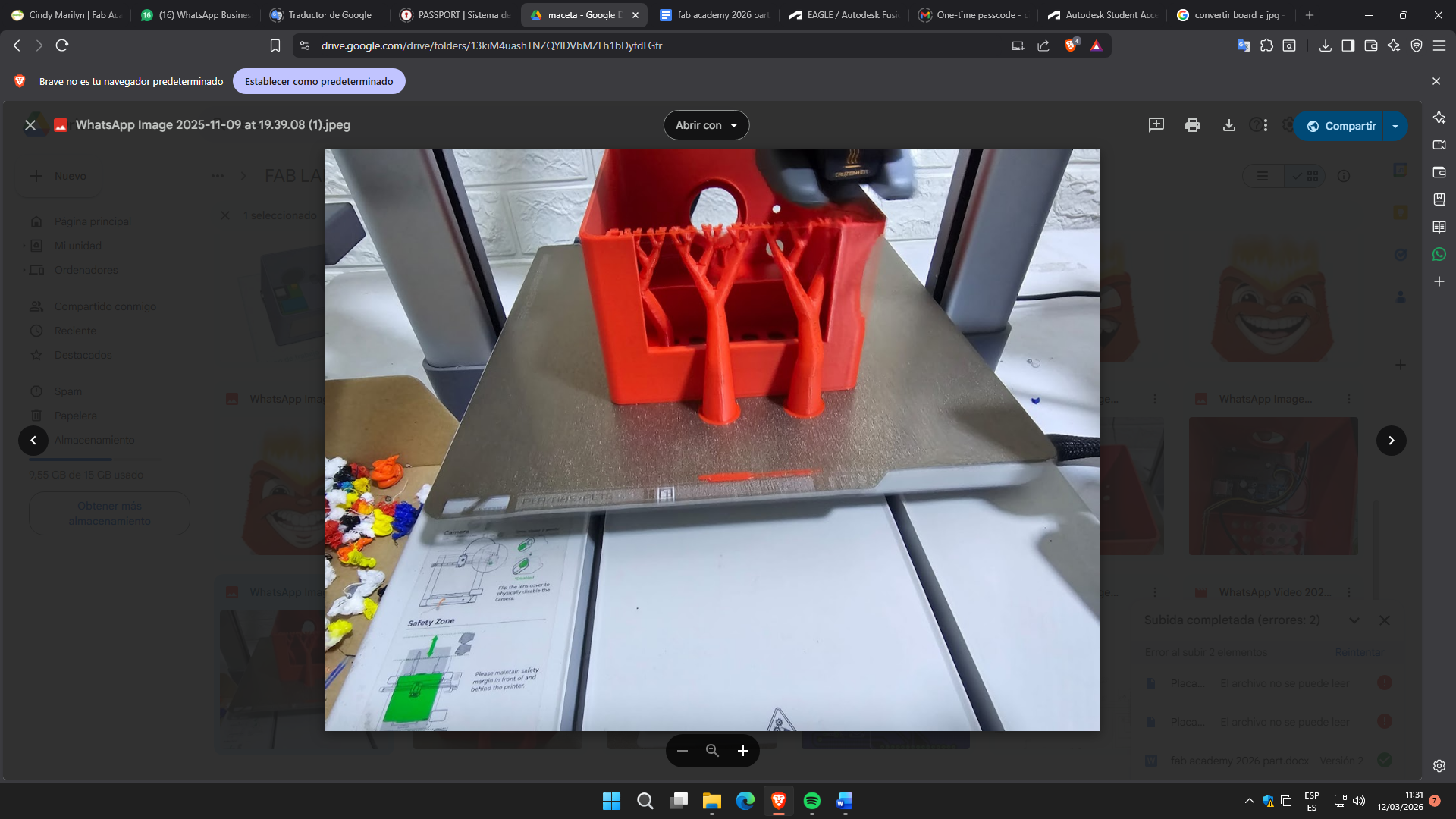
3D printing of the flower pot.
Figure 7. 3D printing process of the plant pot structure.
Bill of Materials (BOM)
Total estimated cost:
$20 – $25
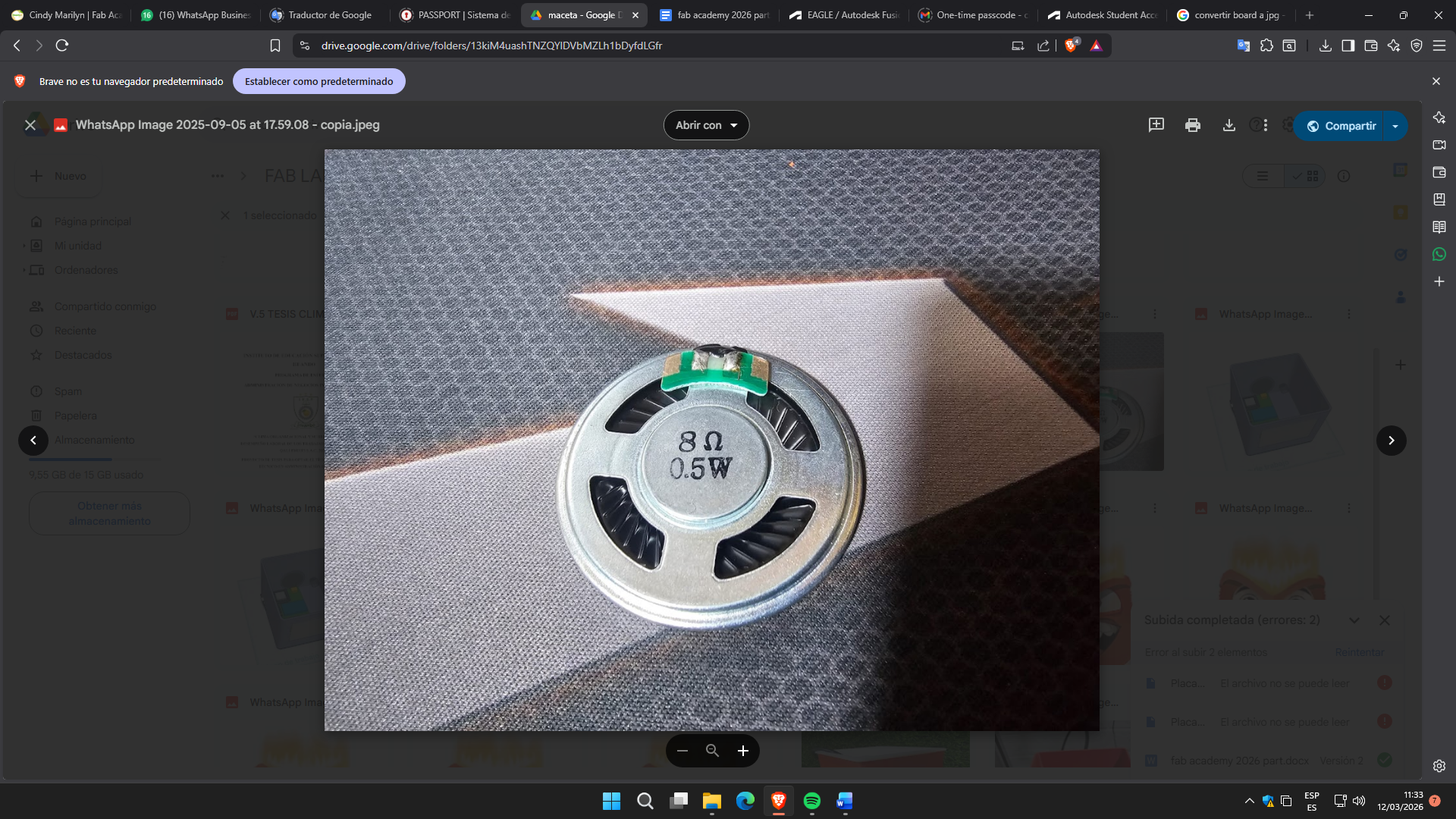
Components on the table.
Figure 10. Electronic components used in the project.
Archivo incluido:
Placa humedad suelo .***
What worked
During the development of the project several elements worked correctly.
✔ the PCB was successfully manufactured ✔ the microcontroller was programmed ✔ sensor detects humidity changes ✔ LED responds to ground conditions ✔ the buzzer activates alerts when necessary
What did not work initially
Some technical problems also arose during development.
• first version of PCB with error in the traces • noise in sensor reading • insufficient internal space in the pot • defective welds
These issues were resolved through redesign and iterative testing.
System Integration
System integration was a key step in transforming the prototype into a functional product.
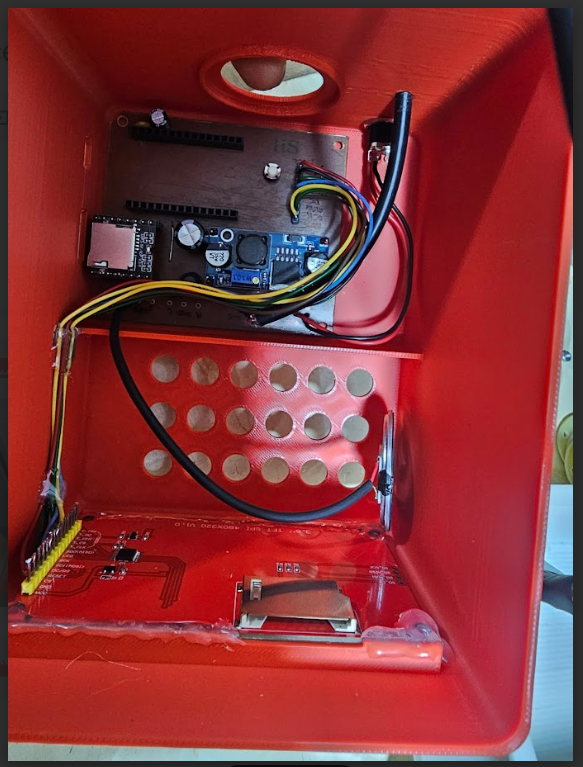
The PCB was mounted inside the 3D printed pot, while the sensor is inserted directly into the soil to measure humidity.
The LED and the buzzer were integrated into the external structure of the device to facilitate interaction with the user.
The internal wiring was carefully organized to avoid loose connections and ensure stable operation of the system.
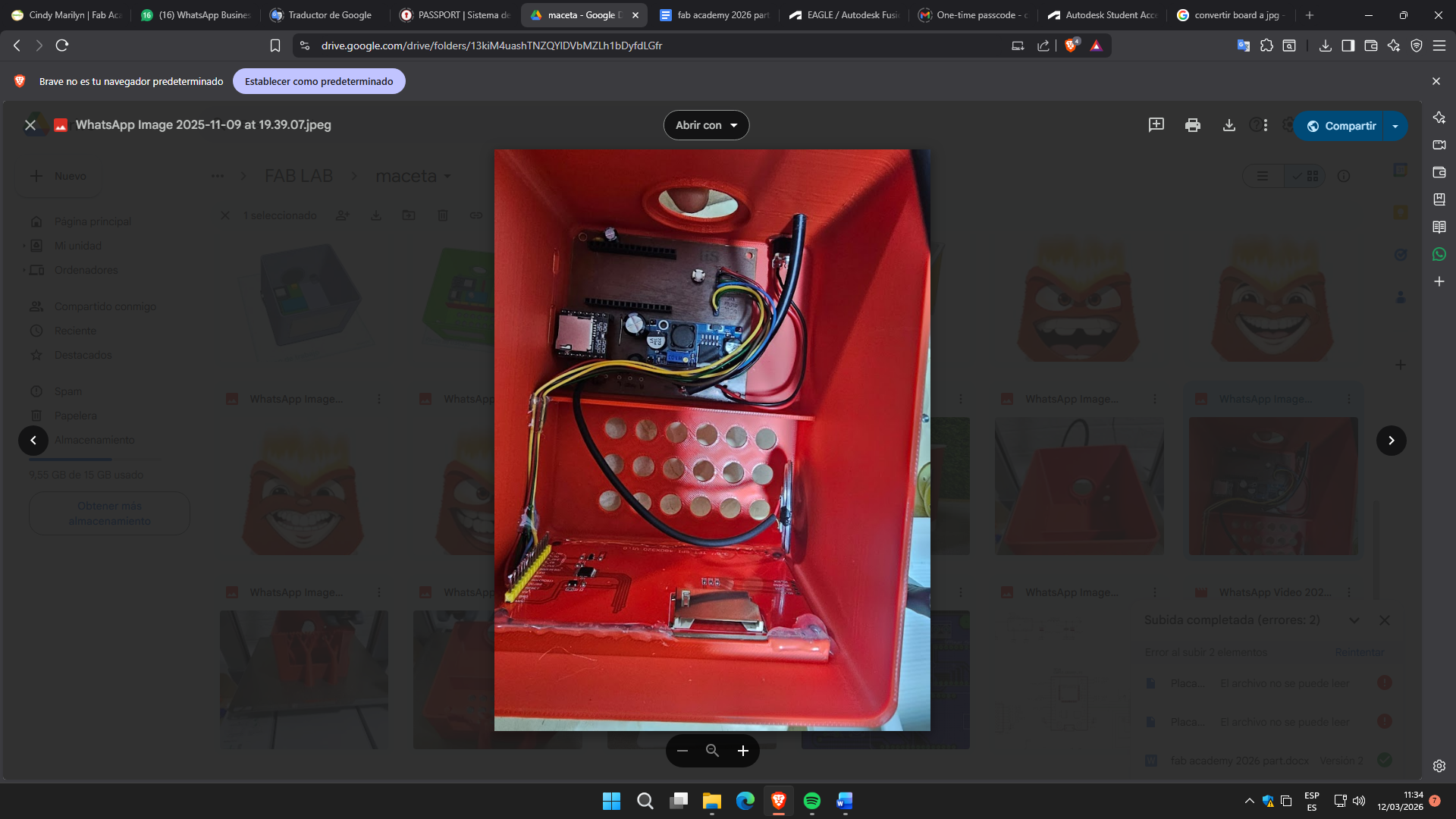
Interior of the pot showing the PCB.
Figure 11. Internal system integration inside the smart plant pot.
Evaluation
The system was evaluated through functional tests to verify its behavior in different humidity conditions.
The project is considered successful if:
✔ correctly detects humidity ✔ LED changes according to condition ✔ buzzer emits alert when the ground is dry ✔ system works autonomously
Implications
This project demonstrates how digital fabrication can be used to develop interactive devices that combine electronics, programming and design.
The Eco Smart Planter has the potential to be used as an educational tool to teach concepts of electronics, sensors and embedded systems.
Posibles mejoras futuras incluyen:
• rechargeable battery • IoT connectivity • PCB miniaturization • production as an educational kit.
Project Concept
My final project is the Smart Plant Pot Eco. It is an intelligent system designed to monitor soil moisture levels and provide immediate feedback to the user, ensuring that plants receive the water they need at the right time.
The core value of this project lies in its ability to bridge technology and nature, using a simple but effective combination of sensors and actuators to promote better plant care and environmental awareness.
Design and Fabrication
The design focuses on a functional and aesthetic housing for the plant and electronics. I used 3D printing to create a custom structure that accommodates the water reservoir, the soil compartment, and a protected space for the PCB.
- Ergonomic design for easy maintenance.
- 3D printed structure optimized for durability.
- Custom enclosure for protecting sensitive electronics.
Electronics and Programming
The heart of the system is an ATmega328P (or ATtiny) microcontroller. I developed a custom PCB that facilitates connections between the soil moisture sensor, an RGB LED for visual status, and a buzzer for audible alerts.
Programmed in Arduino IDE, the system constantly samples soil resistance. When the moisture level falls below a specific threshold, it triggers a "Dry" alert (Red LED/Buzzer), and it returns to a "Moist" state (Green LED) once watered.
Conclusions
There is much room for improvement, such as the location of the power supply and the optimization of internal spaces to reduce costs in future versions.
Demonstration and References
Reference Video (Inspiration)
Project Presentation (Documentation)
Project Files
Download the 3D design and source code of the project.